
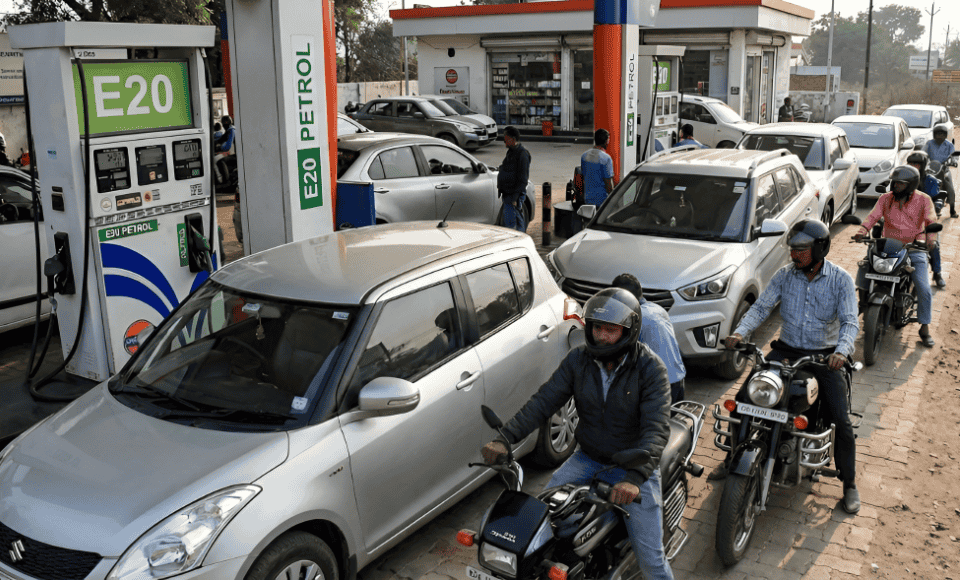
What E20 Fuel Really Means for Car Owners, Mileage, and Long-Term Ownership
Ethanol Blended Petrol in India
For Indian car owners, change has never been optional — only gradual. From BS norms to rising fuel prices and evolving usage restrictions, ownership has adapted quietly. Ethanol blended petrol, especially E20 fuel, is the latest transition. While the policy intent is national, its impact is deeply personal.
This article examines the impact of ethanol blended petrol in India from a car owner’s point of view — fuel cost, mileage, engine life, maintenance realities, and what studies actually say. More importantly, it places these findings within the lived reality of Indian car ownership, where vehicles are kept longer, repaired pragmatically, and emotionally valued.
Understanding Ethanol Blending in India
Ethanol blended petrol combines conventional gasoline with ethanol derived from biomass such as sugarcane and grains. India has rapidly increased blending from E5 to E10 and is now transitioning toward E20 petrol nationwide.
The objectives are clear:
- Reduce crude oil imports
- Support domestic agriculture
- Lower lifecycle emissions
However, ethanol blending impact on car owners varies widely based on vehicle age, design, and usage.
Fuel Cost vs Mileage: The Real Ownership Equation
While ethanol is cheaper to produce domestically, it contains less energy per litre than petrol. This has a direct effect on fuel efficiency.
Studies show:
- E20 fuel mileage reduction ranges from 1–6%
- Modern E20-compatible cars experience lower loss
- Older vehicles experience higher variability
For owners, this often appears as:
“Fuel is slightly cheaper, but refuelling feels more frequent.”
Over time, this subtly alters the cost-benefit equation of running an ageing petrol car.
E20 Petrol and Engine Performance
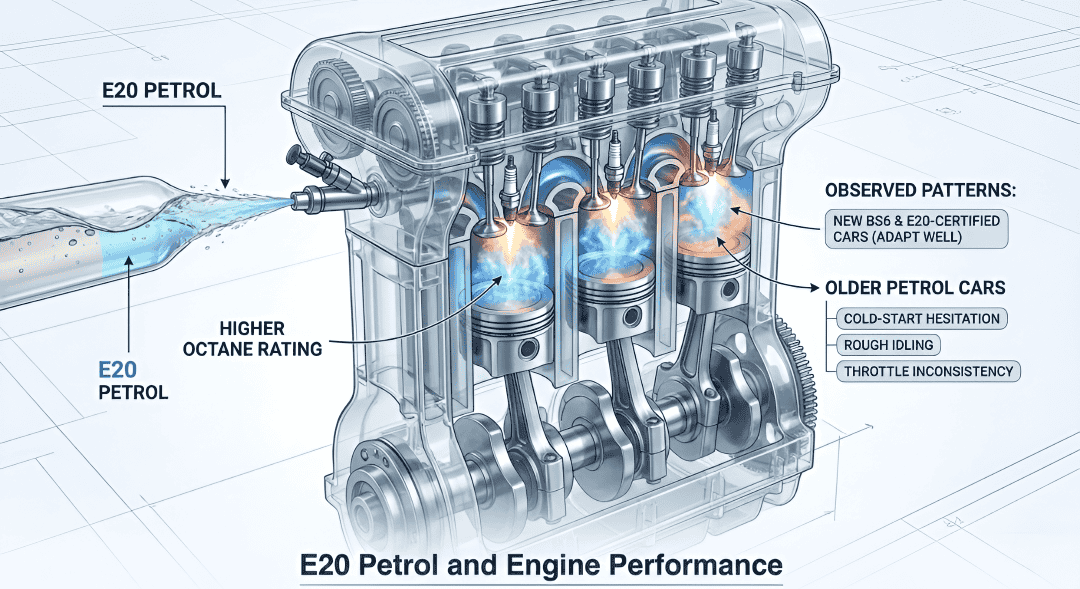
Ethanol has a higher octane rating, which benefits engines designed for it. However, car compatibility with ethanol fuel is not universal.
Observed patterns:
- New BS6 and E20-certified cars adapt well
- Older petrol cars may show:
- Cold-start hesitation
- Rough idling
- Throttle inconsistency
- Two-wheelers and small engines face higher risks
These issues are rarely dramatic — but persistent enough to change the ownership experience.
Materials, Corrosion and Ageing Fuel Systems
Ethanol is hygroscopic, meaning it absorbs moisture. In India’s climate and storage conditions, this matters.
Studies by ARAI and international research bodies show:
- Modern materials tolerate E20 well
- Older rubber hoses, seals and pumps degrade faster
- Issues emerge gradually, not suddenly
For older vehicles, ethanol fuel engine issues are less about damage and more about accelerated ageing.
Engine Life and Maintenance Costs
Contrary to popular fear, ethanol itself does not drastically reduce engine life in compatible vehicles.
Where owners feel the impact:
- Fuel pumps
- Injectors
- Filters and sensors
- Rubber components
For meticulously maintained cars, these are manageable. For long-term Indian ownership, where maintenance is often reactive, these costs quietly accumulate.
Environmental Impact vs Individual Burden
Sugarcane-based ethanol in India shows strong lifecycle emission benefits. However, these gains operate at a system level.
For the individual owner:
- Costs are immediate
- Benefits feel distant
- Compliance pressure feels personal
This mismatch often drives reassessment rather than resistance.
The Indian Reality: Long Vehicle Life, Rapid Policy Change
Most Indian petrol cars outlive global averages. But policy cycles are faster:
- Fuel standards evolving
- Emission norms tightening
- Urban access rules expanding
E20 fuel is not a breaking point — but it often becomes the moment when owners begin asking:
“How long does keeping this car still make sense?”
When Ownership Becomes a Question, Not a Habit
Cars carry memories. Letting go is emotional.
But so is fatigue:
- Rising service costs
- Declining mileage
- Increasing uncertainty
This is where many owners begin exploring options — not urgently, but thoughtfully.
A Responsible Exit When the Time Feels Right

For owners who decide that continuing no longer aligns with cost, compliance, or peace of mind, the transition out of ownership matters.
Platforms like ScrapMyCar exist to ensure that when an owner does choose to move on:
- Valuation is transparent
- Documentation is compliant
- Scrapping is legal and traceable
It is not about pushing a decision — only supporting it when it is made.
Pros and Cons of Ethanol Blended Petrol
Pros
- Reduces oil imports
- Supports Indian agriculture
- Lower lifecycle emissions
- Compatible with modern vehicles
Cons
- Mileage reduction
- Higher wear risk in older cars
- Fuel system compatibility issues
- Accelerates reassessment of ageing vehicles
Final Thought for Indian Car Owners
Ethanol blending is not a disruption — it is a signal. A signal that the automotive ecosystem is evolving.
For some, adaptation is simple.
For others, it invites reflection.
And for those ready to close a chapter, clarity and dignity matter more than urgency.
Change becomes easier when it is supported — not forced.