
Blockchain as the Future of India's Car Industry
Exploring how blockchain technology can revolutionize
vehicle lifecycle management in India, providing
transparency, traceability and efficiency to the automotive
ecosystem while supporting sustainable practices.
Introduction:
The vehicle ecosystem in India is complex and unstructured. Given the size of the country, the number and variety of vehicles, the rules and regulations applying to them, the aftermarket service sector and the spare parts market, it is incredibly difficult to know what is happening. Besides RTO registration documents, there is very little known about the status of a vehicle and this is an issue because untraceable vehicles not only causing huge harm to the environment, but are also an essential tool in criminal activities.
This article aims to present a possible technology-driven solution to control and oversee the lifecycle of a vehicle in India and thus ensure a better and more efficient vehicle management system. It is split into two parts: A quick overview of the life-cycle of a vehicle and then how a national blockchain-base system could impact this cycle by add traceability and value to this sector
Life-cycle of a vehicle without blockchain
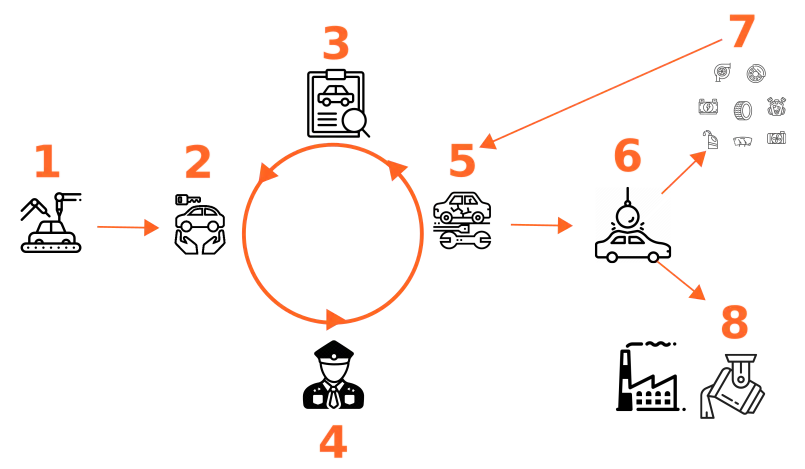
- The car is produced at the factory – this happens only once.
- Ownership change – while this is consistently the second step in a car’s lifecycle, it can happen various times and is the start of a “loop”. The following events of this 4 elements “loop” can happen in random order, none or multiple times.
- Information query: When you buy a second hand vehicle, knowing its history is all about vendor trust, you have very few ways of knowing for sure what happened to the car. Likewise, when the car gets to the mechanic, it is difficult for him to know what has been done to it in the past and when it happened.
- Bad parking, speeding, red light, infraction can occur (eventually multiple times)
- Maintenance and repairs, all cars go through the authorised service centers from time to time, one of those days will eventually end up step 6.
- At some point, the car is deregistered and scrapped;
- Some parts are resold second hand to fix circulating cars (5)
- Some parts are recycled into raw materials to be reinjected on the market.
Blockchain model applied to the car industry
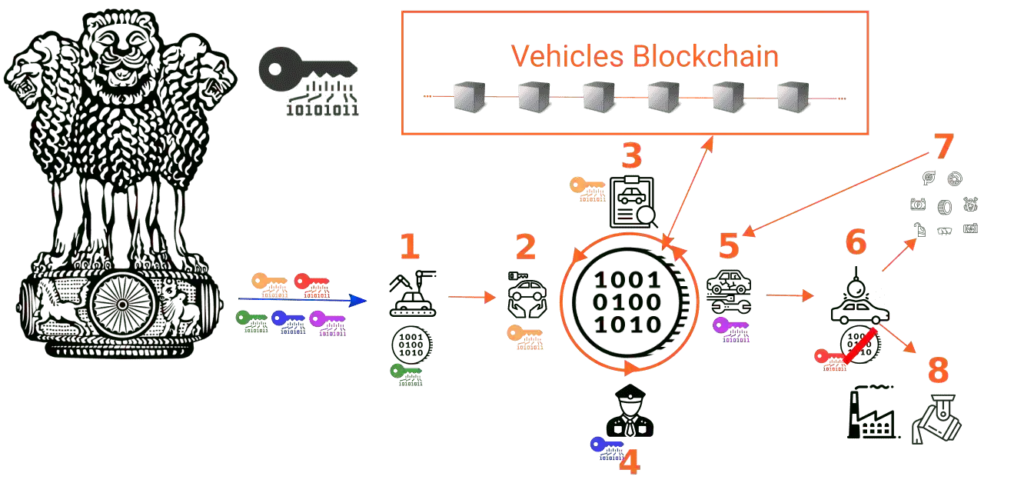
The Ministry of Transport in India is the governing authority and will hold the central keys to the system, as it currently does. It would emit licences - in the form of keys - to the following norms (colors are used as an abstract representation of roles):
- Own one or multiple vehicles
- Request to see a vehicles' information from another key.
- Give or deny a request to see a vehicle's information to another key.
- Initiate an ownership change of vehicle (token) that is linked to this key.
- Confirm a authorised service center intervention
Green Keys
Are only given to companies licenced to sell new vehicles. The green key has the same rights as the orange key, but it has the special right to be able to generate new tokens. Indeed, a unique identifying token must be issued for any new vehicle sold in India.
Blue Keys
Are only given to registered officials like traffic police and are used to register chalans, fines and other legal cases like accidents, crime etc. to the token.
Purple Keys
Are only given to authorised service centers, they are easy to obtain but required, as an authorised service center will have to note some specific data when servicing a car.
- Technical data like emissions and mileage when doing revision
- What has been done to the car when fixing it.
Red Keys
Are only given to licenced scrapers, they allow for property transfer of the vehicle, but are the only keys that can destroy a token.
This system would deploy via an easy-to-use mobile phone app. The actions that a user can do in the app depends on the type of key he owns. The ministry of Transport can oversee, limit and/or revoke a key at any point thus giving it complete control over the ecosystem and ensuring a more efficient and transparent system. It would provide transparency in the used-car and pave the way towards a sustainable India:
It guarantees a seller’s claims about the car (scam’s would be very difficult to execute in this system)
It could help fight pollution much more efficiently than the current system (ELV’s would be identified immediately and would be notified to stay off the roads)
Traceability and responsability is a strong incentive for people to recycle their ELV rather than dumping the old carcasses!
Condition of the car can be relatively well established as any work done on the car (maintenance, parts change) would be visible.
At this point the system still has quite a few limitations, for example What to do when a vehicle is caught in a traffic violation but the driver is not the owner of the car? How can we incentivize ELV owners to recycle their vehicles instead of parking and abandoning it on the roadside and in colonies?
Conclusion:
The automobile sector is an integral part of a much more complex economic system. While it is inconceivable to build a global information system at once, we can build smaller, sector-specific homogeneous systems that can eventually all connect and blend into one seamless, blockchain-based system.
The central government would be the sole executive power with access and control to all the keys in the system and different ministries would manage the keys of their respective sectors. The blockchain system would be compliant with Aadhar (or any other citizen ID) policies.
As an ELV recycling company in India, we started looking at how blockchain technology and crypto certificates could enhance our sector. We realised that their true benefits will only show when their use is generalised true a common standard (just like the internet, it is only useful because it is a common standard). The link with an entity (person or company), smart contracts and what they allow in terms of responsibility, it is the big picture that will allow the whole of India, and not just our car sector, to be a leading force in the digital revolution.
We will keep on researching blockchain technology as we know that will trigger a revolution in the vehicle industry. While the Indian government seems to show growing interest towards blockchain technology, it is sad to see that they did not consider applying it to vehicles.
The government seems to remain reluctant on another use of Blockchain technology, which is CryptoCurrencies, hence we are still waiting to launch our own ICO. Let’s hope our government quickly defines a clear and entrepreneur-friendly legal framework, allowing us to scrape an recycle better.