

Supreme Court Ban on Old Cars in Delhi
What the Judgements Say About BS4 Vehicles and Government Enforcement
For car owners in Delhi and NCR, rules around old vehicles often feel abrupt and confusing. A car that remains mechanically sound can suddenly become non-compliant — not due to failure, but due to Supreme Court and NGT orders aimed at controlling air pollution.
This article explains, in clear terms:
- What the Supreme Court ban on old cars in Delhi actually states
- How BS4 vehicles are impacted
- What “coercive action” legally means
- And how owners can navigate compliance calmly and responsibly
The intent is clarity — not alarm.
How the Supreme Court Got Involved in Old Vehicle Restrictions
Delhi’s air pollution crisis has been under judicial scrutiny for over a decade. Based on expert committee findings and environmental data, the Supreme Court and National Green Tribunal (NGT) concluded that vehicular emissions — especially from older vehicles — are a major contributor.
Because large-scale real-time emissions testing is impractical, courts adopted age-based limits as an enforceable standard.
The key Supreme Court-backed limits:
- Diesel vehicles: Maximum 10 years
- Petrol vehicles: Maximum 15 years
These limits apply regardless of vehicle condition or fitness certificate.
This is the legal foundation of what is commonly called the 15 year car ban in Delhi and 10 year diesel ban in Delhi.
Know more about RTO Rules for Scrapping or Selling Vehicle
Are BS4 Cars Banned in Delhi?
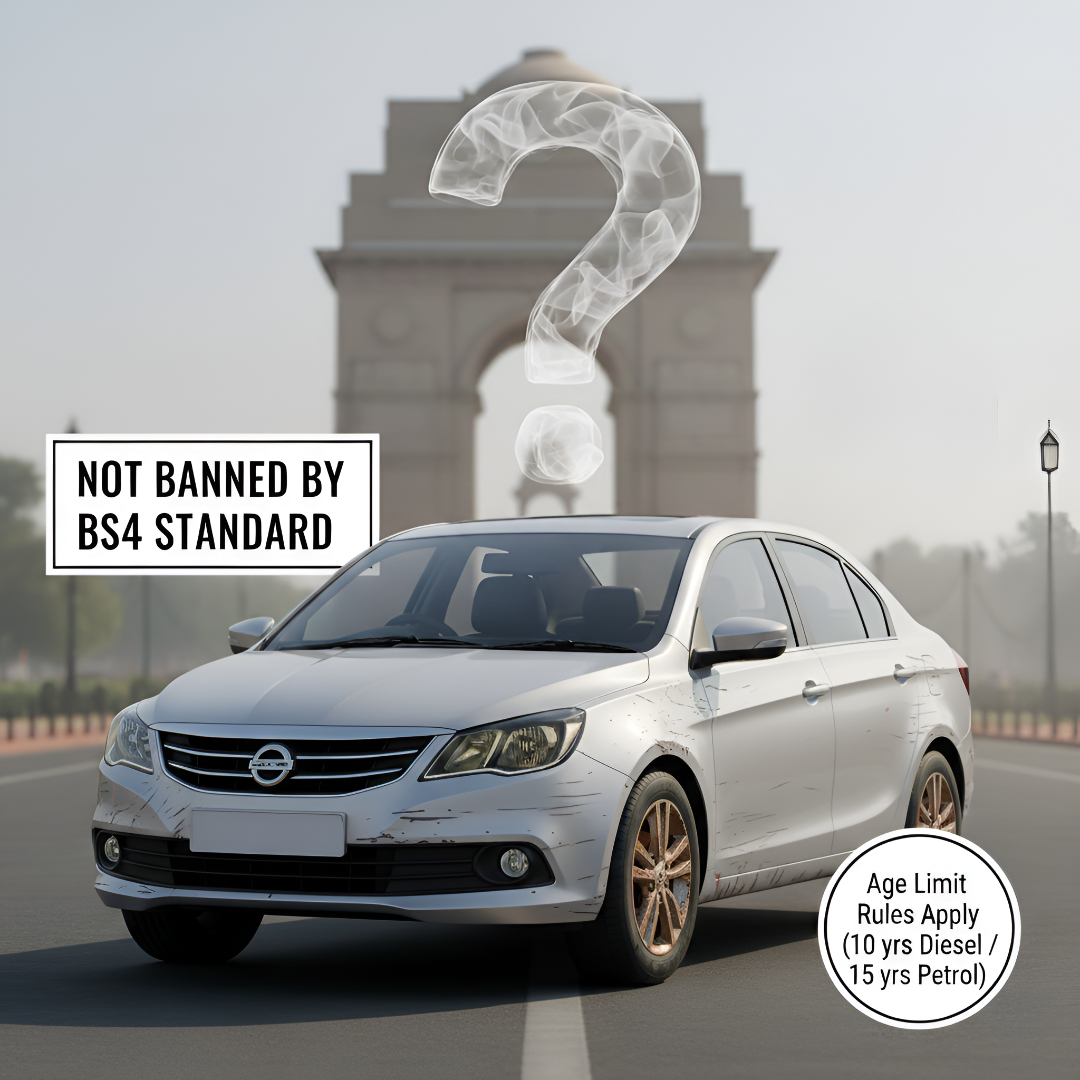
This is one of the most searched and misunderstood questions. BS4 vehicles are not banned solely because they are BS4.
However:
- Most BS4 diesel cars are now approaching or crossing the 10-year limit
- Many BS4 petrol cars are approaching the 15-year limit
- During severe pollution periods (GRAP stages), BS4 vehicles may face temporary restrictions
As a result, many owners perceive a “BS4 car ban in Delhi,” even though the legal trigger remains vehicle age, not emission standard alone.
Why Fitness Certificates Do Not Protect Old Cars
A common concern from owners is:
“My car has a valid fitness certificate. Why is it still illegal?”
The Supreme Court has clearly stated:
- Fitness tests assess roadworthiness, not cumulative environmental impact
- Older vehicles emit higher pollutants even when mechanically sound
- Uniform age limits reduce enforcement ambiguity
Legally, fitness certificates do not override Supreme Court or NGT orders.
This clarification has been reiterated multiple times and is central to enforcement today.
What Does “Coercive Action” Mean for Car Owners?
Supreme Court and NGT orders permit coercive action to ensure compliance. This term often causes anxiety, but it has a specific legal meaning.
Coercive action may include:
- De-registration of the vehicle
- Impounding if found operating illegally
- Mandatory scrapping orders
- Fuel denial through digital integration
- Financial penalties
These actions can only be carried out by government-authorised agencies, not private individuals. Once a vehicle crosses the age limit, continued use in Delhi is a clear legal risk, not a grey area.
Why Enforcement Is Becoming Stricter
Earlier, enforcement relied heavily on physical checks. Today, it is increasingly digitally driven:
- VAHAN database integration
- Fuel station monitoring
- Automatic RC flagging
- Pollution emergency protocols (GRAP)
This reduces discretionary enforcement and increases certainty — for better or worse.
For owners of older vehicles, it means fewer informal workarounds and higher compliance pressure.
The Emotional Reality for Delhi Car Owners
Most Indian car owners keep vehicles far longer than policy timelines anticipate. Cars are maintained carefully, often beyond loan tenures, and carry emotional value.
Age-based bans can feel impersonal, but the courts have consistently prioritised public health over individual exceptions.
Understanding this doesn’t remove frustration — but it helps owners make calm, informed decisions rather than reactive ones.
What Are the Realistic Options Once a Car Becomes Illegal?
Once a vehicle exceeds the Supreme Court-mandated age:
- It cannot be legally driven in Delhi NCR
- Interstate transfer is increasingly restricted
- Continued use risks fines and impounding
At this point, the decision shifts from “Can I keep it?” to “How do I exit ownership responsibly?”
Advisory Support in a Compliance-Driven System
When legal outcomes are predefined, what owners need most is accurate guidance.

This is where advisory platforms like ScrapMyCar play a supportive role:
- Explaining legal standing clearly
- Ensuring scrapping is done through government-authorised RVSFs
- Handling RC cancellation and documentation
- Protecting owners from undervaluation and informal operators
The objective is not pressure — it is peace of mind and compliance.
Key Takeaways for Delhi & NCR Car Owners
- Supreme Court restrictions are age-based
- BS4 vehicles are affected indirectly through age and emergency rules
- Fitness certificates do not override court orders
- Coercive action is legally permitted and increasingly enforced
- Early awareness gives owners control and dignity in decision-making
Final Thought
The Supreme Court ban on old vehicles in Delhi is unlikely to be reversed. Enforcement will only become more consistent. For owners, clarity is power. Understanding the law early allows for choices-rather than compulsion. When decisions are inevitable, having compliant, transparent pathways makes the transition far less stressful.